Aviation, Aerospace
Oil analysis has long been practiced for aircraft engines and other airborne oil-wetted systems such as hydraulic systems and gear boxes in helicopters. Military organizations are ...
行业概览
Oil analysis has long been practiced for aircraft engines and other airborne oil-wetted systems such as hydraulic systems and gear boxes in helicopters. Military organizations are perhaps the number one users of oil analysis testing and commercial aviation also has a long history of oil analysis. A number of airlines throughout the world do their own oil analysis, but in many cases they send samples to commercial oil laboratories. Engine manufacturers also do oil analysis as part of engine development and testing...
主要特点
Oil analysis has long been practiced for aircraft engines and other airborne oil-wetted systems such as hydraulic systems and gear boxes in helicopters. Military organizations are perhaps the number one users of oil analysis testing and commercial aviation also has a long history of oil analysis. A number of airlines throughout the world do their own oil analysis, but in many cases they send samples to commercial oil laboratories. Engine manufacturers also do oil analysis as part of engine development and testing.
Challenges
Aircraft must live up to extremely high expectations for readiness and reliability while operating in extremes of temperature, pressure and humidity. Because of these demands, the engines must be maintained at top performance which drives the need for early detection and correction of engine and lubricant anomalies. Compounding this is the fact that aircraft are often at a given location for a limited period of time before being routed to the next destination. Therefore mechanics need very sensitive measurements of lubricant and component condition with results available in minutes so that they may take the proper action while the aircraft is still in the hangar.
Synthetic Polyol Ester fluids are the fluids of choice to lubricate aircraft gas turbine engines used in commercial and military service requiring MIL-PRF-23699F-STD level performance. It also is used for aircraft-type gas turbine engines in industrial or marine service applications. These synthetic lubricants are formulated to meet the demanding requirements of aircraft type gas turbines operating over a wide range of severe operating conditions. They have excellent thermal and oxidation stability to reduce sludge and varnish deposits and they have a high specific heat. The lubricants also retain viscosity and film strength over a wide temperature range (-40°C to 204° C or -40°F to 400°F).
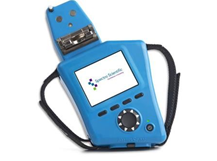
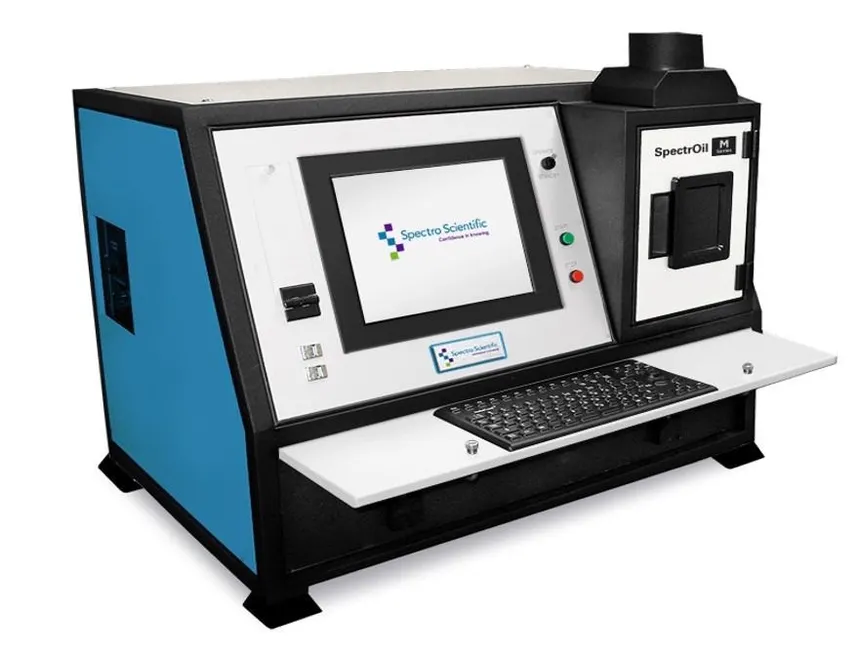
These types of lubricants can exhibit confounding matrix effects when they are analyzed for particles using Optical Emission Spectroscopy. The SpectrOil M accounts for these effects by allowing the user to create custom calibrations to counter these matrix effects, enabling accurate measurement of wear particles.
Challenges
Aircraft must live up to extremely high expectations for readiness and reliability while operating in extremes of temperature, pressure and humidity. Because of these demands, the engines must be maintained at top performance which drives the need for early detection and correction of engine and lubricant anomalies. Compounding this is the fact that aircraft are often at a given location for a limited period of time before being routed to the next destination. Therefore mechanics need very sensitive measurements of lubricant and component condition with results available in minutes so that they may take the proper action while the aircraft is still in the hangar.
Synthetic Polyol Ester fluids are the fluids of choice to lubricate aircraft gas turbine engines used in commercial and military service requiring MIL-PRF-23699F-STD level performance. It also is used for aircraft-type gas turbine engines in industrial or marine service applications. These synthetic lubricants are formulated to meet the demanding requirements of aircraft type gas turbines operating over a wide range of severe operating conditions. They have excellent thermal and oxidation stability to reduce sludge and varnish deposits and they have a high specific heat. The lubricants also retain viscosity and film strength over a wide temperature range (-40°C to 204° C or -40°F to 400°F).
These types of lubricants can exhibit confounding matrix effects when they are analyzed for particles using Optical Emission Spectroscopy. The SpectrOil M accounts for these effects by allowing the user to create custom calibrations to counter these matrix effects, enabling accurate measurement of wear particles.
典型测试与应用
Wear
Particle count - a high particle count or a rapid increase in particles can foreshadow an imminent failure.
Particle composition - it is often important to understand the elemental composition of particles in order to find out where they came from. Optical Emission Spectroscopy gives the user elemental information for up to 32 elements, from Li to Ce (varies with application).
Particle type - The size, shape and opacity of particles is used to determine if they are from cutting wear, sliding wear, fatigue wear, nonmetallic or fibers. This allows operators to determine the type of wear debris, wear mode and potential source from internal machinery components.
Ferrous wear - Ferrous wear measurement is a critical requirement for monitoring machine condition. The high sensitivity magnetometer measures and reports ferrous content in ppm/ml, and provides ferrous particle count and size distribution for large ferrous particles.
Chemistry
Total Acid Number (TAN) - TAN is measured to determine the corrosive potential of lubrication oils. If the TAN gets too high the oil can induce corrosion of machine parts and should be changed.
Viscosity - The main function of lubricating oil is to create and maintain a lubrication film between two moving metal surfaces. Ensuring the viscosity is within recommended ranges is one of the most important tests one can run on lube oil.
Particle count - a high particle count or a rapid increase in particles can foreshadow an imminent failure.
Particle composition - it is often important to understand the elemental composition of particles in order to find out where they came from. Optical Emission Spectroscopy gives the user elemental information for up to 32 elements, from Li to Ce (varies with application).
Particle type - The size, shape and opacity of particles is used to determine if they are from cutting wear, sliding wear, fatigue wear, nonmetallic or fibers. This allows operators to determine the type of wear debris, wear mode and potential source from internal machinery components.
Ferrous wear - Ferrous wear measurement is a critical requirement for monitoring machine condition. The high sensitivity magnetometer measures and reports ferrous content in ppm/ml, and provides ferrous particle count and size distribution for large ferrous particles.
Chemistry
Total Acid Number (TAN) - TAN is measured to determine the corrosive potential of lubrication oils. If the TAN gets too high the oil can induce corrosion of machine parts and should be changed.
Viscosity - The main function of lubricating oil is to create and maintain a lubrication film between two moving metal surfaces. Ensuring the viscosity is within recommended ranges is one of the most important tests one can run on lube oil.
行业资源
支持产品

 Oil Analysis
准备找到正确的解决方案?
我们的团队可以帮助您为您的应用选择完美的产品 Aviation, Aerospace 应用